
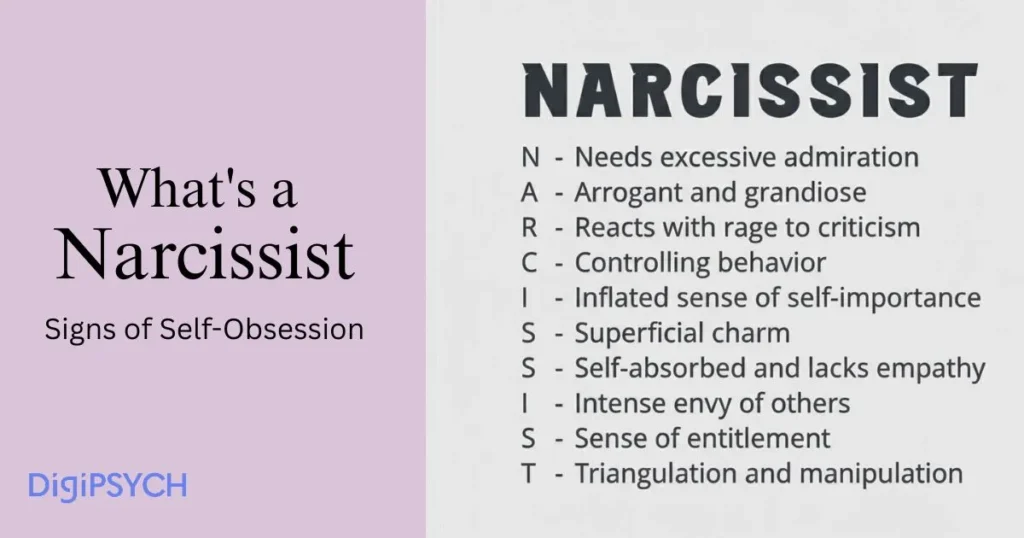
A narcissistic female is a woman who shows excessive self-focus, a strong need for attention and admiration, and a lack of empathy toward others.
NPD, narcissistic personality disorder, is more common in men than women. In the USA, 7.7% of males and 4.8% of females in the general population suffer from narcissism. While males often show narcissism through entitlement, lack of empathy, fantasy of power, and the desire to exploit others or be superior among all, females tend to express it differently, often through greater focus on physical appearance, over-sensitivity, and attention seeking in social settings.
Whether you’re a woman understanding your own patterns or a man trying to understand a partner, friend, or coworker, recognising the signs, causes, and impacts of female narcissism can help you protect your mental well-being, set healthy boundaries, and know when to seek professional support.
What’s Narcissism?
Narcissism is an extreme situation where a person completely negates the needs of those around them. Anyone can have narcissistic behavior once in a while; true narcissists always disregard others and their feelings, always need dominance, and feed their ego.
Narcissism is just a trait of Narcissistic Personality Disorder (NPD). Not every narcissist has NPD, as narcissism is a spectrum. Having narcissistic tendencies, such as bragging or sometimes the urge to dominate, is OK, but NPD is completely different, as its symptoms are more severe and can happen in all kinds of situations. Either way, NPD or narcissism isn’t a personality flaw; it’s a mental health disorder.
What’s a Narcissistic Female?
Narcissistic females have a greater urge of self-obsession, a continuous sense of admiration, and completely lack empathy for others. Unfortunately, females with narcissism may initially look very charming and adorable, but this can be superficial.
We’ll discuss the traits you can use to spot a female narcissist, but as they’re hypersensitive to criticism, they may respond negatively when they feel challenged. These patterns badly impact their relationships as their high self-focus (I, me, and myself) and reactivity make it difficult to maintain healthy relationships.
Narcissistic Traits in Females
Here are 10 common signs you can use to identify narcissism in females.
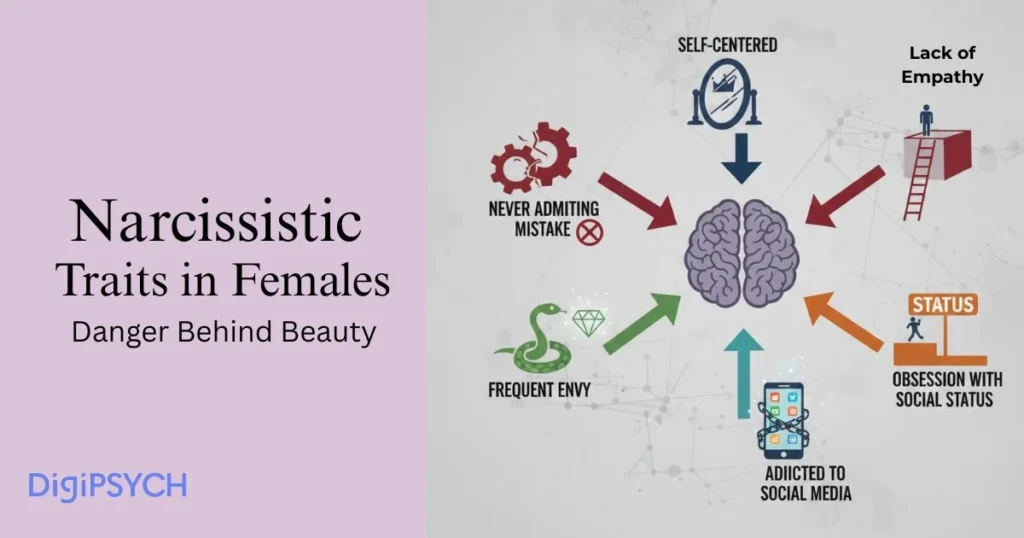
Self-Centered:
It’s the most obvious sign of narcissism. A female narcissist loves talking about herself, her life, and her problems, and doesn’t bother to ask how others are feeling. Even if their friends or family discuss them, they show no interest and quickly turn the conversation back to her.
Never Admitting Mistake:
Narcissistic females never admit they’re wrong. They love to play blame games and make situations or people the bad guy rather than her. They’ll either make excuses or twist the situation, but never admit that they can be wrong.
Frequent Envy:
They often feel jealous of other successful people, and think exactly the opposite, that these people feel envy of me. They belittle or demean the achievements of others. For example, if you tell a female narcissist that you bought a new car, they might not show enough interest or belittle it.
Obsession with Social Status:
Being superficial is very common in narcissism. Female narcissists may show signs of materialism or be preoccupied with brand names, luxury items, or status symbols. If they’re rich, they may disrespect the poor. They’ll always talk about their social status, their reputation, etc.
Addicted to Social Media:
Females with narcissism always need validation, and to seek this external validation, they sometimes turn to social media. They post selfies and become obsessed with likes, comments, and followers, how people appraise their beauty, and like to live in the delusional bubble they’ve created.
Exploiting Others:
Narcissistic females usually exploit others for their self pleasure, personal gain, or just jealousy. They often use manipulative behavior to fulfill their needs, no matter what level of harm it causes to others.
Obsessed with Physical Appearance:
Narcissistic women care more about how they’re looking; they always want to look the most cool and the best in the room. That’s why it’s seen that narcissism in women often leads to excessive shopping, aesthetic procedures, extreme dieting to look smart, or unhealthy obsession with their appearance
Mean Girl:
Male narcissists often express overt forms of aggression that are usually evident, but female narcissists behave differently, such as backbiting, gossiping, spreading rumors, name-calling, or giving others a cold shoulder at home or at work. These are all actually forms of narcissistic abuse that can be harmful and disturb the lives and relationships of others around. After doing all this, narcissistic females still play the victim card and never admit their mistake.
Sensitive and Reactive:
Female narcissists are very emotional, which makes them sensitive and reactive. They’re sensitive to criticism, they fear failure, and they’re very confined to their comfort zone, fearing challenges and rejection. This sensitivity often makes them feel more hurt, offended, or upset by others, which leads them to lash out or shut down when wounded instead of dealing with empathy.
Instability in Work, Life, and Relationships:
As narcissistic females have different behavioral problems, oversensitivity, jealousy, self-obsession, and manipulation, all these factors disturb their personal and professional lives, which sometimes further worsen their symptoms. They struggle to succeed in professional life, manage finances, keep friendships, and build relationships. As a result, this hollowness or failure further increases their narcissistic traits.
Signs of Covert Narcissism in Females:
In this type of narcissism, females usually feel like their friends, family, or partner owes them.
- They believe they deserve payback and often feel sad or resentful
- They always think others are better than her and need consistent validation
- They often play the victim card in disputes
- They are hypersensitive to criticism
- They’ve weak self-esteem and often show dependency in relationships.
While we completely understand that dealing with narcissistic females is hard, similarly, if you’re a female reading this and evaluating your narcissism, don’t worry and don’t feel alone. Narcissism is manageable with therapy and behavioral changes. Call our helpline if you need help!
What Causes a Female to be Narcissistic?
The causes of narcissism aren’t fully discovered as of now. But like other mental health illnesses, it’s usually linked to:
- Environment or family history
- Kids who are brought up the way to believe that they are extraordinary and they always deserve the best
- Childhood trauma
- Lack of love or negligence
Unfortunately, there is no gene to blame for NPD; people are not born with it, they’re raised this way.
How to Deal With a Female Narcissist?
Dealing with a female narcissist is hard. Here are some compassionate yet practical ways to deal with them without compromising your own mental health:

- Educate yourself about narcissism and learn her patterns. Understand the fact that she is mentally suffering, and you need to show patience to an extent that doesn’t affect your mental or emotional health.
- Build your self-esteem because a narcissist would likely attack it. A healthy self-esteem would help you encounter her negativities easily.
- Do self-talk, journaling, and practice self-care.
- Advocate for yourself when it is important. Though silence is gold but it’s not always recommended because if you bear it once, they may start treating you like this again. At least show some annoyance or signal them that it’s your boundary line, you won’t allow others to cross.
- Set clear boundaries. Though narcissistic females still might not respect it, at least you would have played your part.
- If your relationship with them is unavoidable, like if she is your wife, mother, sister, or boss, practice skills to stay calm. Do deep breathing, yoga, meditation, write a diary, pray, and just drain yourself. Don’t hold their negativities inside you.
- Find a support system. Interact with new people, engage in volunteer activities, join a gym, or engage in a hobby to keep your mental and emotional health intact.
- Narcissistic females are good at making empty promises just to avoid that difficult situation. Ask them for immediate actions and behavioral changes.
- Don’t hate narcissistic females, because most of the time, they’re not doing it intentionally; they’re suffering mentally. Gently encourage them to seek mental health therapy and guide them with compassion and sincerity.
- If their behavior is impacting you negatively, and she is abusing you mentally, emotionally, or physically, and she doesn’t agree on seeking mental health help, understand it’s time to move on.
If you fear any harm from another person, call the National Domestic Violence Hotline at 800-799-7233 to get shelter across the United States.
Is Narcissism Curable?
Yes, narcissism is manageable with talk therapy, also known as psychotherapy, and medications if required for the underlying cause of depression, anxiety, or other conditions. There is no specific medicine for NBP.
Psychotherapy helps you regain control of your life, build healthy relationships once again, and be successful in your professional life.
Psychotherapy helps you to overcome narcissism in the following ways:
- It helps you to break barriers or unrealistic expectations and accept yourself the way you are.
- It improves your self-image and builds self-confidence and self-esteem.
- It helps you to communicate better and improve your relationships with your loved ones
- It helps you understand the root causes of your narcissistic approach, what triggers it, and why you dislike others or sometimes yourself
- It helps you to understand your potential and accept criticism, challenges, and failures
- It helps you develop emotional intelligence
- It helps you to set realistic goals with practical steps to achieve success
Therapy can be short-term to help you manage stress, or it can be provided on a long-term basis until you fully achieve your goals. If your relationship has been affected because of narcissism, couples psychotherapy may help.
Conclusion:
Female narcissists are usually self-obsessed, mean, and manipulative. They usually struggle in building successful personal, professional, and family life, and they always play the blame card. But the sad part is, most of the time, they’re not doing it knowingly, but they’re mentally suffering. Guide them to take psychological help to get out of this loop and start living happily with confidence, peace, and empathy again.
Lastly, Digipsych offers online telepsychiatry services for narcissistic behavior. Our expert psychiatrist, Dr Hussain, will help you understand the root cause of your behavior and how to change it step by step, how to reset your life and correct your relationships, ultimately helping you to overcome narcissism and start living with emotional intelligence.
If you or your loved ones need help, don’t hesitate to reach us. Our compassionate care and non-judgmental approach make you comfortable to share your struggles that too from the comfort of your home, according to your ease.
FAQs:
What does a female narcissist look like?
A female narcissist apparently looks charming and adorable. But on the other side, she is self-obsessed and doesn’t have the strength to bear criticism or correct herself when wrong. She always needs attention and validation, and she only expresses her true personality after some time, not at the beginning of a relationship.
How to spot a narcissistic woman?
If a woman loves to talk about herself, her life, her problems, and doesn’t care about what you feel, or never gives you a chance to express yourself. she never accepts her mistake and always puts the responsibility of being wrong on others’ shoulders. If she always needs validation, has low self-esteem, fears failure and rejection, gets jealous of others, manipulates, and puts others in trouble for her pleasure, she is probably a narcissist. But still, sometimes it’s just temporary, and there could be some underlying cause for it. We can’t label someone narcissistic for one-time behavior, but definite repetitive patterns for long-term falls the person into the category of narcissist.
Can a woman be a narcissist?
Yes, a woman can be a narcissist. But the tendency of narcissism is more in men (7.7%) than in women (4.8%).