
Most people don’t struggle with anxiety all day. They struggle at night. During the day, you’re busy. You’re functioning. You’re handling things. But once the lights go off and the house goes quiet, your mind starts replaying conversations, imagining worst-case scenarios, or worrying about things you can’t possibly fix at midnight. That’s when it becomes hardest to fall asleep when anxious, because your brain feels like it’s still in work mode.
If you’re anxious and can’t sleep, it’s not because you’re doing something wrong. It’s because your nervous system hasn’t learned how to feel safe in stillness yet.
At DigiPsych, this is one of the most common patterns we see, people who are “fine” until bedtime and then suddenly overwhelmed by anxious feelings at night. Let’s talk about why that happens and what actually helps.
Why Anxiety Shows Up So Strongly at Night
Night time anxiety isn’t random. It’s predictable. When stimulation drops, your brain fills the silence. During the day, your attention is pulled outward. At night, it turns inward. Thoughts that were pushed aside finally surface. There’s also a biological piece to this.
In quiet environments, the brain’s threat detection system becomes more sensitive. A racing heart, shallow breathing, or a tight chest, sensations that might go unnoticed during the day, suddenly feel alarming in bed. Fatigue makes it worse.
When you’re tired, your emotional filter is thinner. Worries feel heavier. Problems feel bigger than they really are. That doesn’t mean you’re in danger. It means your system is exhausted and on high alert at the same time.
The Vicious Loop Between Anxiety and Sleep
Here’s where things tend to spiral. You have one or two bad nights. Then bedtime starts feeling stressful. You begin worrying about sleep itself. By the time you lie down, your body is already bracing for another long night.
This is how anxiety at bedtime becomes conditioned. Your brain starts associating the bed with frustration, not rest. Even if you’re exhausted, your nervous system stays switched on because it thinks it needs to protect you. The key point here, and this matters, is that forcing sleep never breaks this cycle. It usually strengthens it.
Stop Trying to Sleep
This sounds counterintuitive, but it’s one of the most effective shifts you can make. Sleep cannot be forced. The harder you try, the more pressure you create, and pressure is the enemy of sleep. Instead of aiming to “fall asleep,” aim to rest. That permission alone often lowers anxiety at bedtime enough for sleep to arrive on its own.
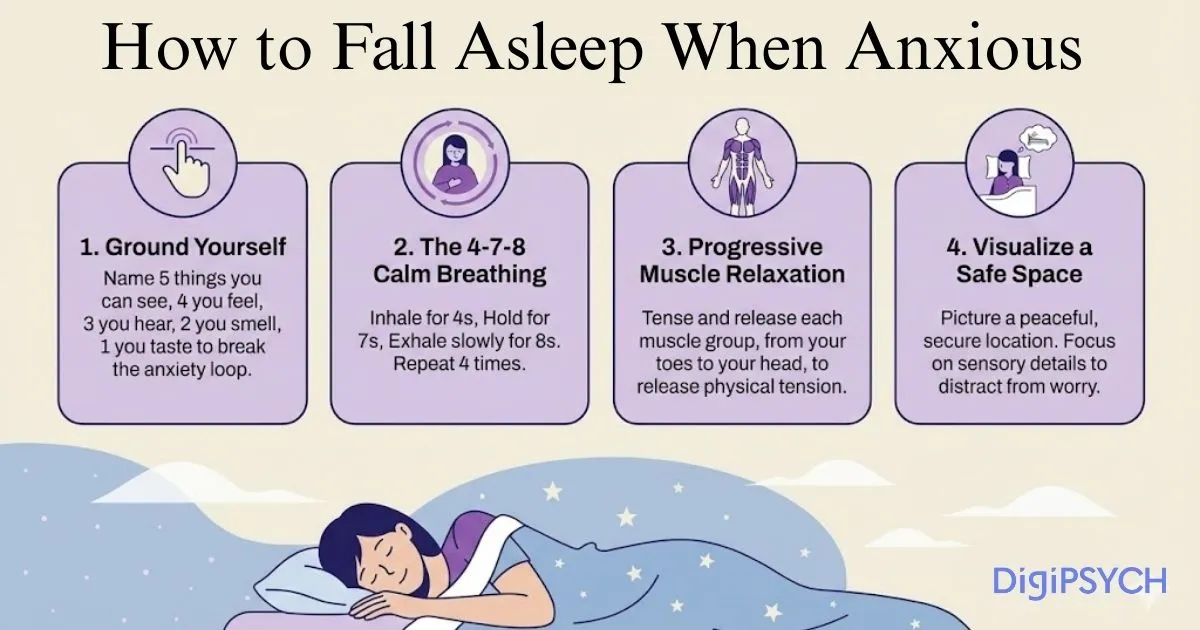
Some people also benefit from practical techniques to fall asleep faster, such as breathing, muscle relaxation, and visualization exercises.
Tell yourself you’re allowed to lie there without sleeping. You’re allowed to just be still. That permission alone often lowers anxiety at bedtime enough for sleep to arrive on its own. Even quiet rest helps your body recover.
Your nervous system needs safety more than it needs unconsciousness.
Calm the Body Before You Calm the Mind

Anxiety doesn’t start as a thought. It starts as a physical response. That’s why thinking your way out of anxiety at night often doesn’t work. Your body is already activated. Slow breathing helps, but not the kind where you “take a deep breath” and tense up.
What works better is lengthening the exhale. Longer exhales tell your nervous system that the threat has passed. Gentle muscle release can help too. Not aggressive stretching. Just noticing where you’re holding tension and letting it soften a little.
When the body settles, the mind usually follows. Trying to do it the other way around is much harder.
When Your Thoughts Won’t Shut Up
Racing thoughts are one of the most frustrating parts of night time anxiety. The mistake most people make is arguing with their thoughts or trying to stop them. That rarely works. A more helpful approach is labeling.
When a thought pops up, quietly acknowledge it as “anxiety thinking” rather than the truth. You don’t need to solve it. You don’t need to respond to it. Some people find it helpful to get worries out of their heads before bed. Writing them down earlier in the evening can reduce how urgently they demand attention at night.
Others benefit from neutral background sound, something calm enough not to stimulate, but present enough to prevent the mind from spiraling inward.
How to Relieve Anxiety Before Bed With Simple Signals
Your nervous system learns through repetition, not logic. A consistent bedtime routine tells your body what’s coming next. Over time, this becomes a cue for safety. In fact, simpler is better.
- Maintain a consistent bedtime routine to signal safety to your body.
- Perform calming activities in the same order each night.
- Avoid stress-inducing activities, such as heavy conversations, intense problem-solving, or distressing content close to bedtime.
- Keep the routine simple and predictable to reduce nervous system activation.
- Remember: your brain reacts similarly to mental effort and perceived threats.
The key is doing roughly the same calming activities, in the same order, each night. Avoid emotionally heavy conversations, intense problem solving, or distressing content close to bedtime.
Your Environment Matters More Than You Think
Light, temperature, and noise all affect how safe your body feels. Bright lights and screens signal alertness. Dimming lights in the evening helps your brain release melatonin naturally. A slightly cooler room tends to support better sleep. Many people also benefit from expert advice on improving sleep when anxiety is high, which combines practical routines with clinically informed strategies.
Quiet helps too, though some people prefer gentle background noise over silence. The goal isn’t perfection. It’s reducing friction. Anything that makes it easier for your body to let go is worth paying attention to.
Daytime Habits That Quiet Night Time Anxiety
What you do during the day directly affects how your body and mind feel at night.
- Avoid caffeine late in the day, as it can increase nighttime anxiety.
- Eat consistent meals to stabilize blood sugar and prevent anxiety spikes.
- Engage in regular movement, which helps regulate stress hormones.
- Get exposure to daylight to support a healthy circadian rhythm.
- Be cautious with alcohol, as it may seem calming initially but can worsen anxiety and disrupt sleep later.
Research shows that regular exercise, consistent meals, and avoiding caffeine close to bedtime significantly improve sleep quality.”
When Anxiety at Bedtime Stops Being Occasional
Everyone has bad nights. That’s normal. But if anxiety at bedtime is happening most nights, or if sleep loss is affecting your mood, focus, or relationships, it may be time for support.
Evidence-based approaches like cognitive behavioral therapy for anxiety and insomnia are particularly effective because they address both the thoughts and the nervous system patterns involved.
The National Institute of Mental Health notes that anxiety disorders are common and highly treatable with the right interventions. You can read more about this from their official resource.
How DigiPsych Helps With Anxiety and Sleep
At DigiPsych, we don’t treat sleep issues as isolated problems. Anxiety and sleep are deeply connected, and lasting change comes from addressing both.
Support focuses on understanding triggers, reducing nervous system reactivity, and rebuilding a sense of safety around rest, not forcing quick fixes. For many people, just having their experience understood is a powerful first step.
A More Realistic Way to Think About Sleep
If you’re anxious and can’t sleep, it’s easy to assume something is wrong with you.
There isn’t. Your body is trying to protect you. It just hasn’t learned yet that nighttime is safe again. That learning takes patience, not pressure. Some nights will still be hard. That doesn’t mean you’re back at square one. Progress with anxiety is rarely linear.
Learning how to fall asleep when anxious isn’t about eliminating anxiety forever. It’s about changing how you respond to it, especially at night. If night time anxiety is starting to feel unmanageable, reaching out for support can make a real difference. If you’d like to explore professional guidance tailored to anxiety and sleep challenges, you can connect with DigiPsych through our Contact Us page and take the next step toward calmer nights.
FAQS
How to calm anxiety to sleep?
To calm anxiety before sleep, use deep breathing, progressive muscle relaxation, and a consistent bedtime routine. Create a quiet, dark environment, avoid screens 1 hour before bed, and try calming activities like light stretching or meditation. These techniques lower stress hormones and signal your body that it’s time to rest.
Why can’t I fall asleep when anxious?
When you’re anxious, your body releases stress hormones like adrenaline and cortisol, which trigger the fight-or-flight response. This increases heart rate, breathing, and brain activity, making it hard to relax and fall asleep.
Why is anxiety so bad at night?
Anxiety is worse at night because the brain has fewer distractions and becomes more focused on worries. The quiet and darkness make negative thoughts louder, while stress hormones stay elevated, preventing relaxation and sleep.
How can I fall asleep fast if I have anxiety?
To fall asleep fast with anxiety, use 4-7-8 breathing or progressive muscle relaxation, and follow a calming bedtime routine. These methods slow your heart rate and reduce tension, helping your mind shift into sleep mode quickly.
What is the best sleep position for anxiety?
The best sleep position for anxiety is sleeping on your side because it helps your nervous system relax and reduces body tension. Sleeping on your back with a pillow under the knees can also help some people feel calmer.